You have fifteen tabs open with vacuums, and the difference between bagged and bagless still looks like a detail. It isn’t. We’ll go through eight basic differences you’ll notice with every clean, say who gets the point in each round, and at the end we’ll give you a clear recommendation.

Bagged vs. bagless vacuum cleaner: Which one comes out on top? An 8-round showdown
30. 8. 2026
You have fifteen vacuum cleaner tabs open, and the difference between bagged and bagless still looks like a minor detail. It isn’t. We’ll go through eight key differences you’ll notice every time you clean, say who gets the point in each round, and give you a clear recommendation at the end.
- There are eight differences, but two are decisive: running costs and suction stability. The bagless vacuum cleaner with a HEPA H13 filter wins on both.
- The bagged model scores a point for quieter operation and easier maintenance. With the bagless model, you wash the filter once every two weeks and replace it roughly three times a year.
- Choose a bagged model only if greater quietness is essential to you or if an allergy sufferer will be emptying the dust.
Quick overview
| # | Souboj | Sáčkový vysavač | Bezsáčkový vysavač | Bod vyhrává |
|---|---|---|---|---|
| 1 |
Kde končí prach
|
v sáčku | v průhledné nádobě | princip, ne bod |
| 2 |
Pořizovací cena
|
u základních modelů bývá nižší | srovnatelná, u tyčových ji tvoří hlavně baterie | sáčkový |
| 3 |
Provozní náklady
|
ano, dokupuješ nové sáčky | občas je potřeba nový filtr | bezsáčkový |
| 4 |
Sání během úklidu
|
klesá s plnícím se sáčkem | drží stabilně, dokud je filtr čistý | bezsáčkový |
| 5 |
Údržba
|
výměna sáčku, občas filtr | nádoba, filtr a čištění kartáče | sáčkový |
| 6 |
Prach a alergie
|
prach zůstane v sáčku | s HEPA H13 fouká čistý vzduch | remíza |
| 7 |
Hlučnost
|
nejtišší od 63 dB | nejtišší od 70 dB | sáčkový |
| 8 |
Ekologie
|
sáčky za celou životnost vysavače, končí v koši | občas filtry, případně 1× baterie | bezsáčkový |
Showdown #1: Where the Dust Ends Up
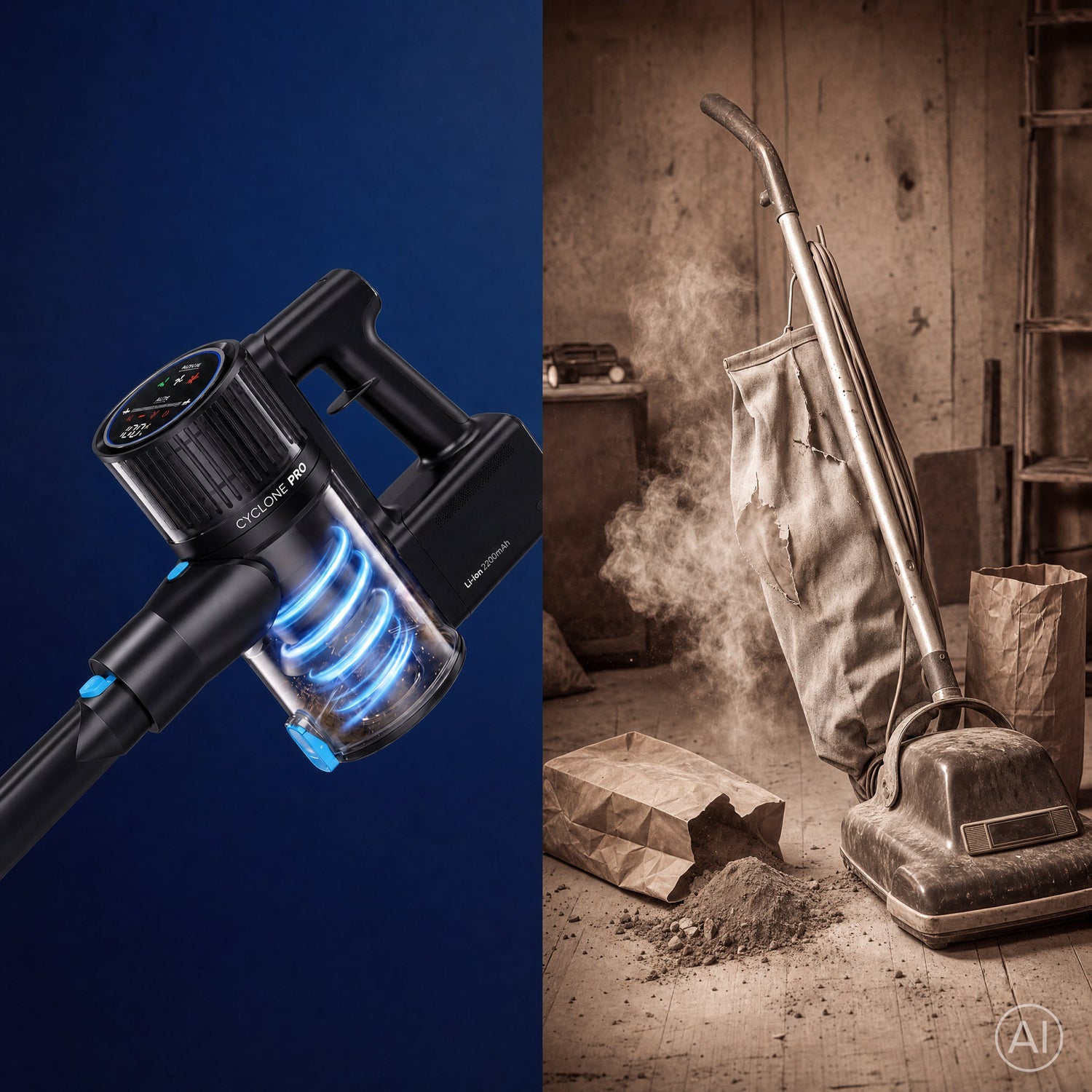
Bagged vacuum cleaners work just like the ones you’ve known since childhood (or perhaps seen at your grandmother’s). You plug them in, switch them on, and the dust disappears into the bag. Once the bag is full, you take it out, throw it away, and put in a new one.
Bagless vacuum cleaners suck dirt into a plastic container, so you can see inside. For the first time, you’ll find out what and how much is actually floating around your home, and you can also see when it’s time to empty the container.
Inside, cyclone filtration works in three steps:
- The air spins into a spiral.
- Centrifugal force hurls the heavier particles against the walls of the container.
- They fall to the bottom, while the air continues on without them.
You then simply empty the container into the bin and put it back.
A tip from Niceboy: Do not put fireplace ash, fine construction dust, or liquids into a bagless container. They bake together inside into a layer that you then have to dig out, and it’s not good for the filter. A bag handles this better. If you have a fireplace at home or are currently renovating, take this into account when choosing your vacuum.
Winner: Nobody. This showdown simply sets the rules for the seven that follow.

Match #2: Purchase price
Here, the bagged vacuum cleaner strikes right in the shopping basket. Basic bagged plug-in models are often cheaper than most cordless stick vacuums - but it doesn't have to be the rule; here at Niceboy, our stick vacuums start in the low thousands.
The reason for the higher price? With a cordless stick vacuum, you're paying for the battery, an efficient brushless motor and often a charging stand too. A plug-in vacuum doesn't have to deal with any of that because it draws its power from the mains and weight isn't as much of a concern.
Winner: Bagged (but only for the first few packs of bags).
Showdown #3: Operating costs
Buying a bagless vacuum cleaner is a one-time investment. With a bagged vacuum cleaner, your costs increase with every use. One pack of bags after another, and after ten years, you have a sum you never budgeted for.
So, in a way, you’re buying a bagged vacuum cleaner on (almost) endless installments, you just call them consumables.
And besides, we all know Murphy’s law: Bags always run out at the worst possible moment. Guests arriving in an hour, and the pack is empty.
But we won’t promise you zero costs with a bagless vacuum cleaner. It also has consumables, just far fewer of them. For our stick vacuums, we recommend replacing the filter approximately every four months, so three times a year. You use the container for the entire lifetime of the vacuum cleaner.
- Bagged: bags over and over again, plus a filter from time to time
- Bagless: a filter approximately three times a year and nothing else
Winner: Bagless. Three filters a year are still less than a pile of bags.
Showdown #4: Suction during cleaning
This difference is the trickiest because it only becomes apparent halfway through vacuuming.
Bagged vacuum cleaner suction gradually decreases as the bag fills up. Air has a harder time getting out, the motor has to work harder, and you have to go over the same spot ten times. You’ll notice it especially on carpets.
Bagless vacuum cleaner keeps its performance stable as long as the filter is clean and the container isn’t overfilled. When the suction noticeably weakens, you usually just need to wash the filter and you’re back to square one.
Winner: Bagless.

Round #5: Maintenance
Bagged vacuum cleaners have maintenance sorted in one move: replace the bag and forget about it. Bagless vacuum cleaners make things a little more complicated because they require some care from you:
- empty the container after every cleaning
- rinse the filter once every 15 to 30 days, depending on how often you vacuum
- replace the filter with a new one roughly every four months
- let the filter dry completely before putting it back
People most often cut corners on the last point. A damp filter then restricts suction, and you curse at the vacuum cleaner even though it isn't to blame.
What's more, every container has a specific, limited capacity. In a large house, you'll empty it several times during a single cleaning session.
What about hair on the brush?
Check the discussions under any vacuum cleaner and you'll keep running into the same problem: Hair and pet hair get tangled in the brush. This happens with both types because it isn't about the bag, but about what happens in the nozzle. People then take out scissors from time to time and cut through the tangled layer. On some models, the brush can't even be removed, so they have to deal with it directly in the nozzle.
The solution is called an anti-tangle brush. Hair can't find anything to catch on, so it goes straight into the container. The Niceboy Hurricane H7 Plus has one, while on the Niceboy Hurricane H9, the Animal Brush does the same job.
And one more honest note. Bagged vacuum cleaners have a reputation among users for being more durable because they don't contain a battery or a cyclone that could become clogged. We don't have hard statistics to back this up, but it comes up in discussions so often that we won't hide it.
Winner: Bagged. Ten minutes spent on the filter per month is still ten minutes.
Round #6: Dust and allergies
Here, you need to look at the issue from two angles.
During vacuuming, the bagless vacuum with a HEPA H13 filter wins. This is the highest commonly used filtration class, and in our vacuum cleaners it captures up to 99.95% of particles measuring up to 0.06 micrometres. Pollen, dust mites, fine street dust. The vacuum cleaner therefore doesn't blow back into the room what you just vacuumed up.
However, the bag wins when it comes to emptying. Close it, throw it away, done. Emptying the container on a bagless vacuum cleaner is simply dustier, and an allergy sufferer will notice.
Practical solution: Hold the container low over the bin, or empty it outside.
Watch out for one exception. Our stick and robot vacuum cleaners have a HEPA H13 filter. The only model in the current range that doesn't have one is the Niceboy Hurricane F5. If you're dealing with allergies, skip this one.
Winner: Draw. It depends on which of these two angles matters more to you.
Round #7: Noise level
Noise level is a specification you skip in an online shop because you don't know what to imagine from the dB values, and then you listen to it for ten years.
Bagged vacuum cleaners are generally quieter. Partly because the bag dampens the noise a little, but the main difference comes from the design. A canister vacuum cleaner has its motor hidden in a body full of insulation, while you hold a stick vacuum with the motor almost next to your ear.
In numbers: The quietest bagged canister vacuum cleaners reach 63 dB, while the quietest stick vacuums are around 70 dB. Our stick vacuum cleaners range from around 75 to 78 dB.
But this isn't a rule. Bagged upright vacuum cleaners commonly range from 68 to 80 dB, so the louder ones can drown out a stick vacuum in energy-saving mode. Noise is also usually measured when the vacuum cleaner is running at full power, so when you're not using the maximum setting, you're a bit lower.
So if you're specifically looking for a quiet vacuum cleaner because you vacuum in a flat on Sunday morning or have a sleeping baby at home, this difference is worth considering.
Winner: Bagged, but only by a narrow margin.
Round #8: Environmental impact
The final round is about what you leave behind. Bags are something like coffee machine capsules. Convenient until you count how many you throw away in a year.
The bag ends up in general waste because it's full of dust and can't be sorted. X pieces a year, for ten years straight... That creates a pile you'd never want to see all together.
With a bagless vacuum cleaner, you already know how it works: you empty the container, rinse it and use it throughout the vacuum cleaner's entire lifespan. The filters are what go in the bin, roughly three a year.
To be 100% fair: Batteries in cordless vacuum cleaners also have a limited lifespan. That's why you should check whether the battery can be replaced separately. For example, you can remove it from both the Niceboy Hurricane H7 and Niceboy Hurricane H7 Plus, so the end of the battery doesn't mean the end of the vacuum cleaner.
Winner: Bagless.
A tip from Niceboy: Take a look at our section with accessories.
Which type is right for whom
Eight rounds are behind you. This is a shortcut if you want a direct answer for your situation.
| Tvoje situace | Co ti doporučíme |
|---|---|
|
Alergik doma, nádobu vysypává někdo jiný
|
bezsáčkový s HEPA H13 |
|
Alergik vysypává sám a je citlivý
|
sáčkový |
|
Chceš co nejnižší cenu při koupi
|
sáčkový |
|
Chceš co nejnižší provozní náklady
|
bezsáčkový |
|
Topíš v krbu nebo doma řešíš stavební prach
|
sáčkový |
|
Dlouhé vlasy nebo chlupatý mazlíček v domácnosti
|
bezsáčkový s protinamotávacím kartáčem |
|
Tvoje priorita je co nejtišší vysavač
|
sáčkový |
|
Byt do 3+1
|
bezsáčkový tyčák |
|
Dům s více patry
|
robot na denní úklid a tyčák na doladění |
Apartment or house?
None of the eight rounds addresses this question, but it may still determine to some extent whether you’ll be happy with your vacuum cleaner.
An apartment with up to 3 rooms and a kitchen can be handled by a bagless stick vacuum on a single charge. It also works well as a small vacuum for an apartment because you can hide it behind the door in its stand without it taking up half your storage space.
A two-storey house is a different league. You’ll be watching the battery like a fuel gauge halfway down the highway. Either keep that in mind and go for a model with a replaceable battery, or leave the regular daily cleaning to a robot and use the stick vacuum only for the stairs and corners.
So who won?
In summary: 3 points for the bagless model, 3 points for the bagged model, one tie and one round without a winner. If we only added up the points, we wouldn't get very far. However, the criteria in each comparison carry different weight, and you can assign that weight yourself based on what matters most to you.
Our verdict is as follows:
You deal with running costs and declining suction every time you clean, for 10+ years in a row. Noise and the five minutes spent cleaning the filter can be solved by getting used to them during the first month. And the purchase price? The bags will pay you back with interest. That's why, for most households, a bagless vacuum cleaner with HEPA H13 is the better choice.
A bagged vacuum cleaner still makes sense in one case: when the person changing the bag has a problem with dust.
And one more thing while you're choosing. You can't identify the best vacuum cleaner by the watts on the box. A vacuum cleaner's power consumption only tells you how much electricity it uses. Actual suction is described by suction power in kilopascals, so if you want a powerful vacuum cleaner, look for kPa.
Bagless Niceboy vacuum cleaners that make sense
Niceboy vacuum cleaners are bagless and cordless, while keeping our prices lower than competitors with comparable features.
| Model | Sací výkon | Výdrž na nabití |
Prachová nádoba |
HEPA H13 |
Komu sedne |
|---|---|---|---|---|---|
Niceboy Hurricane H7 |
20 kPa, motor 200 W |
až 40 minut | 600 ml | ✅ | byt do 3+1, konec se sáčky za rozumné peníze |
Niceboy Hurricane H7 Plus |
26 kPa, motor 300 W |
až 50 minut v ECO, 15 minut v POWER | 600 ml | ✅ | dlouhé vlasy a psí chlupy, má protinamotávací kartáč |
Niceboy Hurricane H9 |
30 kPa, motor 400 W |
až 50 minut v ECO | 0,5 l | ✅ | nejsilnější sání v řadě, kartáč Animal Brush na chlupy |
Niceboy Hurricane H7
Sací výkon
20 kPa, motor 200 W
Výdrž na nabití
až 40 minut
Prachová nádoba
600 ml
HEPA H13
✅
Komu sedne
byt do 3+1, konec se sáčky za rozumné peníze
Niceboy Hurricane H7 Plus
Sací výkon
26 kPa, motor 300 W
Výdrž na nabití
až 50 minut v ECO, 15 minut v POWER
Prachová nádoba
600 ml
HEPA H13
✅
Komu sedne
dlouhé vlasy a psí chlupy, má protinamotávací kartáč
Niceboy Hurricane H9
Sací výkon
30 kPa, motor 400 W
Výdrž na nabití
až 50 minut v ECO
Prachová nádoba
0,5 l
HEPA H13
✅
Komu sedne
nejsilnější sání v řadě, kartáč Animal Brush na chlupy
BESTSELLER


NEW


BESTSELLER


Niceboy tip: Don't always vacuum at maximum power. The most common mistake we see with stick vacuums? Turning on the highest power, vacuuming the entire time, and then having to run to the charger shortly afterward. For everyday dust, crumbs, and pet hair on the floor, a lower setting is all you need. With the Niceboy Hurricane H9, SMART mode takes care of this for you by automatically increasing the power where there's more dirt.
Save maximum power for what it's designed for: Long-pile carpets, ground-in sand, or a one-off deep clean. You'll notice the difference right away, because the battery lasts around 15 minutes at maximum power, but up to 50 minutes on a lower setting (depending on the model). Use full power only where you need it.
Niceboy Hurricane H7
Bagless 2-in-1 with a HEPA filter, a 600 ml dust container and up to 40 minutes of runtime on a single charge. Turn it from a stick vacuum into a handheld vacuum with one click, so you can handle the sofa and stairs with the same device.
- Who it's for: an apartment up to 3+1 rooms, where you want to say goodbye to bags without spending a fortune.
- Limitation: in a large house, you'll have to empty the container more often. The rotating brush isn't tangle-free, so if someone in your household has long hair, you should look at the H7 Plus instead.
- Extra plus: you can remove the battery and charge it separately, so it can be replaced over time.
Niceboy Hurricane H7 Plus
Basically our H7, just with a boosted 300 W motor and suction power of up to 26 kPa. But you’ll notice the main difference not in the suction, but in the floor head. It has an anti-tangle brush, so you won’t have to cut out hair and pet fur with scissors.
- Who it’s for: households with long hair or a dog, where a tangled brush is your biggest annoyance.
- Limit: the fifty minutes applies to ECO mode, while POWER lasts fifteen.
- Extra plus: you can remove the battery just like with the H7.
Niceboy Hurricane H9
The more powerful 2-in-1 with a 400 W motor, suction power of up to 30 kPa and up to 50 minutes of runtime on a single charge. It comes with a charging stand, a set of attachments including the Animal Brush for pet hair, and SMART mode, which automatically adjusts the power according to the level of dirt. After cleaning, just put it in the stand and you’ll start with a full battery next time.
- Who it’s for: larger households where one go means the living room, bedroom, kitchen and hallway too.
- Limitation: the dust container holds 0.5 l, so slightly less than the H7. You get more runtime and power, but you’ll have to empty it more often. And the 50 minutes applies to Eco mode. At maximum power, it will run for significantly less time, which generally applies to cordless stick vacuums.
- Sibling: the Niceboy Hurricane H7 Plus is an H7 with a boosted 300 W motor and suction power of up to 26 kPa. It has an anti-tangle brush, so you won’t have to cut out hair with scissors, and its battery can be replaced.

And if you don't want to vacuum at all: Charles
A stick vacuum is just one option. Charles robot vacuums are also bagless and have a HEPA H13 filter. The difference is that you turn them on and walk away. They handle the basic cleaning themselves, and you come back to a clean home.
Niceboy Charles i6 collects dust in a container, so you don't need to buy any bags for it. It runs for up to 120 minutes on a single charge, and when the battery runs out, it recharges itself and returns to where it stopped. The dust container holds 650 ml, more than any of our stick vacuums. You can wash the HEPA H13 filter under running water, it can mop too, and at 65 dB, it is quieter than any of our stick vacuums.
- Who it's for: anyone with mostly hard floors who wants everyday cleaning to get done without them.
- Limit: the navigation is gyroscopic, not laser-based, so it maps less effectively than more expensive robots with LiDAR. It also can't get over thresholds higher than 1.5 cm.
That's eight rounds behind you, along with the decision you've been putting off. Cleaning doesn't have to take up its own space in your calendar after all. Just press a button. Your style, your home.
Frequently asked questions
What is the main difference between a bagged and bagless vacuum cleaner?
Where the vacuumed dirt ends up. A bagged vacuum collects it in a paper or fabric bag, while a bagless vacuum collects it in a plastic container with cyclonic filtration. This leads to all the other differences, especially running costs and suction stability.
Is a bagless vacuum cleaner suitable for allergy sufferers?
Yes, if it has a HEPA filter. It traps pollen, dust mites and fine dust, so they do not get blown back into the room. The weak point is emptying the container, which creates more dust than replacing a bag. Have someone else do it, or empty it outside.
How often should the filter in a bagless vacuum cleaner be cleaned?
Empty the container after every cleaning so nothing builds up inside. We recommend rinsing the filter once every 15 to 30 days, depending on how often you vacuum, and replacing it with a new one roughly every four months. Always let it dry completely before putting it back. A damp filter restricts suction.
Do hair and fur get wrapped around the brush?
Yes, with standard rotating brushes, and it is the most common complaint among vacuum cleaner owners. It is not limited to bagless vacuums. Bagged models with a rotating nozzle have the same issue. A tangle-free brush helps. It comes with the Niceboy Hurricane H7 Plus, while the Niceboy Hurricane H9 has an Animal Brush.
Can I vacuum up ash or construction dust with a bagless vacuum cleaner?
We do not recommend it. Fine particles cake together in the container, are difficult to empty and clog the filter. For fireplace ash and construction dust, use a bagged vacuum cleaner or a workshop vacuum cleaner designed for coarse dirt.
Does a bagless vacuum cleaner lose suction power like a bagged one?
Not in the same way. A bagged vacuum gradually loses suction continuously as the bag fills up. A bagless vacuum keeps its power stable as long as the filter is clean and the container is not overfilled. When suction weakens, washing the filter is usually enough.
Is a bagged vacuum cleaner still worth it today?
In two situations. If you do not want to deal with emptying dust, or if quiet operation is very important to you. In every other respect, especially running costs and convenience, bagless models come out on top.
Is a bagless vacuum cleaner louder?
Generally, yes, but the bag is not the reason. The difference comes from the design: a floor vacuum cleaner has its motor enclosed in an insulated body, whereas you hold a stick vacuum with the motor next to your ear. The quietest bagged models run at 63 dB, while the quietest stick vacuums run at 70 dB. You will notice the difference in an apartment building or when a child is sleeping.